
Rutgers Foundation launches emergency campaign to protect the site
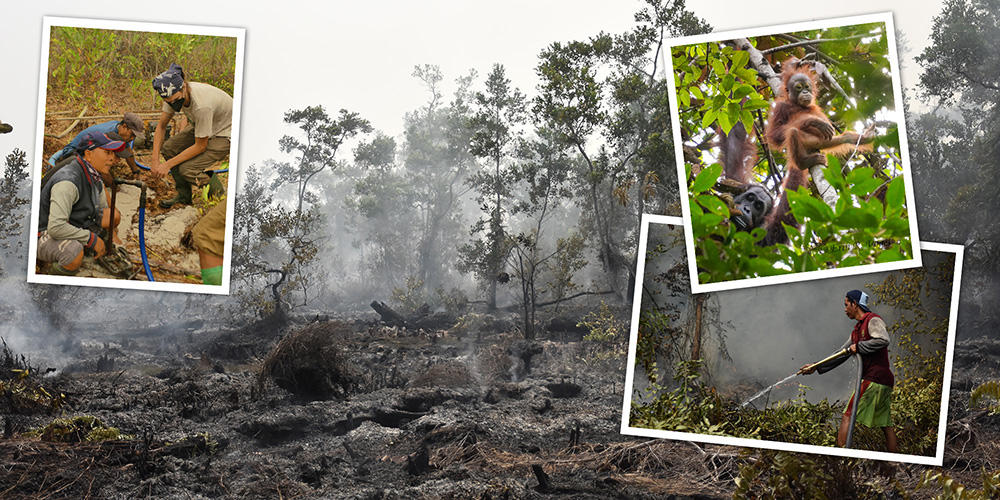 Wildfires in Borneo are endangering the Tuanan Research Station and the wild orangutans that are the subject of its studies. Currently, Rutgers researchers are supporting local community members who are fighting the fires.
For more than two decades, Rutgers University researchers have conducted up-close studies of the wild orangutans of Borneo from a remote, forested stretch of Indonesia.
Now, wildfires are threatening the great apes and raising fears that the research station might have to be evacuated.
The crisis has prompted the Rutgers University Foundation to launch an emergency fundraising campaign to protect the Tuanan Orangutan Research Station, a sprawling facility that serves as both research lab and a residence for the team.
Besides being one of the preeminent centers for the study of orangutans, the station—located in Central Kalimantan on the island of Borneo—supports an array of research projects on such topics as tropical forest ecology, wildlife conservation, biodiversity, and climate change.
 "We're very committed to this research," says Erin Vogel, co-director of the Tuanan Orangutan Research Station. “If these fires continue to spread, they could destroy decades of long-term scientific research, place both wildlife and local communities at risk, and release millions of tons of carbon dioxide into the atmosphere,” said Erin Vogel, co-director of the station and a professor of anthropology at the Rutgers University–New Brunswick School of Arts and Sciences.
In September, the surface and underground fires spreading toxic smoke across Indonesia came within 500 meters of the station, prompting researchers to pack up their equipment in the event of an evacuation.
“All the cameras, all the binoculars, all the iPads, everything we use is all packed up and stored in one room right now of the research station,” Vogel said. “So that if they do have to evacuate, they can get it out quickly.”
Although wildfires are common to the region—the station faced threatening fires in 2015 and 2019— the destruction from the current crisis could surpass previous years due to an unusually dry summer and the onset of a “super El-Nino” weather pattern. So far, the fires have burned up 895,657 hectares, or about 2.2 million acres.
“I've seen this beautiful, vibrant green space become swathed in heavy yellow smoke,” says Nathalie Grothues, SAS’26, a research assistant at the station. “The vegetation near the road is as dry as paper. The orangutans are searching for water, lethargic in the heat.”
Graduate student Natalie Robinson said the fires could have a devasting impact on the orangutans, the largest tree-dwelling mammals in the world.
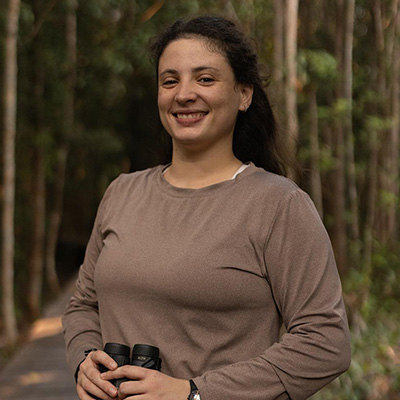 Graduate student Natalie Robinson: "It is a deeply emotional experience to come here as a researcher trying to understand this peatland ecosystem, only to find yourself fighting to protect it from burning." “Smoke exposure has been shown to disrupt endocrine function in many species,” said Robinson, a PhD candidate. “Fires like these could have lasting consequences for female orangutans’ reproductive cycling.”
The station, which opened in 2003, is run by Rutgers in partnership with the Universitas Nasional in South Jakarta, through a cooperative agreement with Indonesia’s Ministry of Forestry that was facilitated by the Borneo Orangutan Survival Foundation (BOSF)
The station is located within a conservation area—a peat swamp forest that’s home to orangutans, gibbons, bears, and other endangered species. Peat swamps are made up of layers of partially decomposed organic materials such as decaying plants. The lack of rain has dried out the swamps, making them highly flammable.
“The fires can follow peat deep underground and pop up in places that you don't expect,” Grothues said in a video that the station produced to document the crisis. “The only way to extinguish the fires is by re-saturating the soil over a very long period of time.”
The campaign by the Rutgers Foundation aims to raise $100,500 that will fund firefighting equipment, support for local volunteer firefighters, safety gear, and transportation.
 Nathalie Grothues, SAS'26: "We researchers pitch in where we can, assisting the firefighters, bringing them food and water." Several units at Rutgers have contributed to the cause, including SAS, the School of Environmental and Biological Sciences, and the Center for Human Evolutionary Studies.
The station has long employed a small crew of local residents who are trained to fight fires. But the current crisis has far outstripped their resources. And many of the country’s professional firefighters are busy battling blazes in Palangkaraya, the largest city in Central Kalimantan.
“We're so remote that we're just hiring local community members right now,” Vogel said. “They want to save the forest too, because they know how important that forest is, especially for their culture and their ancestry.”
While locals and firefighters sent by BOSF battle the blazes, the students are patrolling the conservation area, scouting out signs of new fires. In addition, the station’s staff manager is flying a drone to get a wider view of what’s happening in the forest.
“Our team is doing a great job at quickly locating the fires,” Vogel said.
But much more help is needed, especially with the continuing dry spell from El Nino. The foundation's campaign will allow for the purchase of an array of supplies, including hoses, pumps, generators, communications equipment, and fire retardant soap.
“Fighting these fires is like playing whack-a-mole,” Vogel said. “You put one fire out and then a new one pops up.”
The stakes are high, Vogel added.
 "Tuanan has been at the heart of my research for several years," said graduate student Eva Hernandez-Janer. "It is heartbreaking to see it threatened by these fires again."The station has been steadily growing in size and stature, training over 260 students and publishing 150 peer-reviewed studies. In a recent study led by Vogel, researchers found that survival strategies of the great apes offer lessons for human health in the ways they avoid obesity through diet and exercise.
“It's definitely one of the well-known research stations in Indonesia at this point,” Vogel said. “We've established it really well.”
And as the current crisis shows, the station has forged an enduring connection with the local community.
“Tuanan is much more than a research site,” says PhD candidate Eva Hernandez-Janer, whose research focuses on the effects of these fires on orangutan health. “The local community’s knowledge, expertise, and commitment make this work possible, and they are also on the front lines when fires threaten the forest.”
Vogel agreed, saying that the combination of research excellence and close community has kept her involved with the station since she joined the team as a postdoc in 2004.
“I never thought that I would still be here 22 years later,” she said. “But we’re very committed to the research, committed to the local community, and committed to each other.
“And that’s something Rutgers can be proud of.”